
By James Bryant, Director of Insights and Culture

James Bryant, Director of Insights & Culture
This February, Reconciliation Services pauses to honor the ground we stand on — literally and figuratively. The building at 3101 Troost Avenue sits at the corner of what was once the James Porter Plantation, one of the most significant slave-holding properties in Kansas City's history. The soil beneath our feet carries the memory of men, women, and children who were enslaved here — who built wealth for others with their bodies while being denied the most basic dignities of human life. We do not take that lightly. We take it as a calling.
She Saw the Corner Differently.
When Thelma Altschul co-founded what would become Reconciliation Services, she wasn't simply opening a nonprofit. She was expanding on the work she was already doing in a community riddled with trauma, homelessness, violence, and addiction, feeding, housing,clothing and loving her neighbor which became even stronger in her life as an Orthodox Christian. She was planting a flag of redemption on contested ground. Thelma believed that the same communities that had been exploited, displaced, and overlooked deserved to be the center of something life-giving — something that said you belong here, you are seen, you matter here, you are served here.
Her vision was radical in the truest sense of the word — going to the root. At the root of Kansas City's racial and economic divide was Troost Avenue, a street that became one of the most notorious racial dividing lines in American urban history, systematically engineered by redlining policies, restrictive covenants, and deliberate disinvestment that devastated communities of color for generations.
Thelma looked at that divide and decided to build a bridge. She decided a gathering place is truly possible.
What We've Built on That Ground.
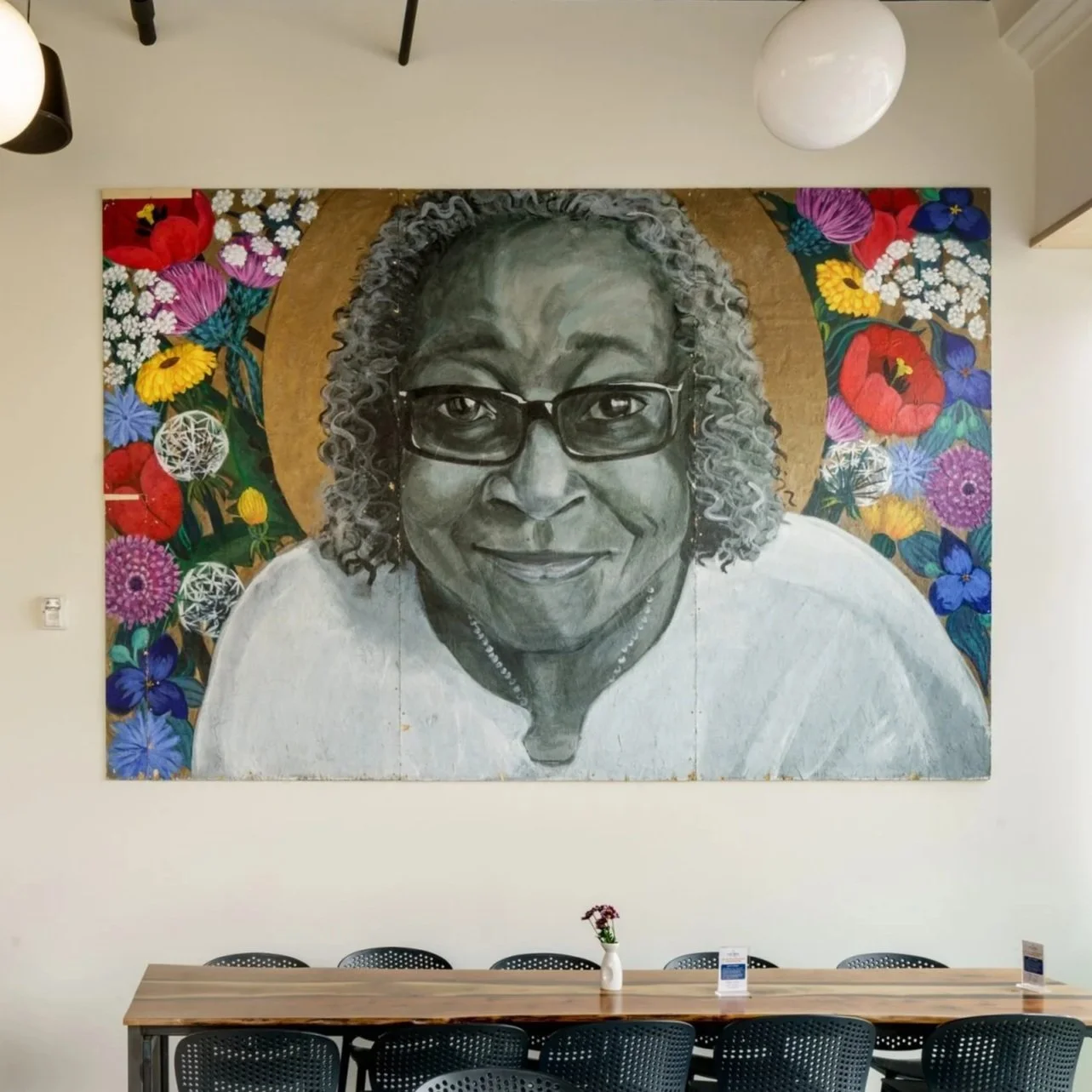
A mural of Thelma Altschul in Thelma’s Kitchen
Today, Reconciliation Services honors Thelma's legacy by continuing to transform 3101 Troost into a living, breathing example of what equity looks like in practice:
Thelma's Kitchen — named in her honor — is more than a café. It is a pay-it-forward community space where a grandmother from the East Side sits across from a professional from the suburbs, where a child experiencing food insecurity gets a meal with dignity, and where intergenerational, interracial, and intereconomic relationships are built over a shared table. Where the REVEAL Works Workforce Development Cohort supports employment opportunities, and RS Advocates engages volunteers and donors to use their time and talents to advance community wellness in a city where segregation was enforced by law and custom, and eating together is still a revolutionary act.
Foster Grandparents places adults 55 and older — many of them from communities that have survived systematic and systemic neglect — into public school classrooms as mentors and supporters for children who need exactly what they have to give: wisdom, patience, and love that no curriculum can replace. This program invests in two generations at once, honoring elder knowledge while nurturing young lives.
REVEAL provides Emergency Support, Case Management, and Individual and Group Therapy — because systematic and systemic racism and trauma doesn't just affect zip codes and bank accounts. It lives in the body. It lives in the mind. Communities of color bear a disproportionate burden of trauma, and REVEAL exists to say: healing is your human right, not a privilege.
Missouri Has a Complicated History. We're Committed to an Honest Future.
Missouri was a slave state. Kansas City's development was shaped by policies that intentionally concentrated poverty in Black and Brown communities. The Troost divide didn't happen by accident — it was systematically engineered. And the consequences — in health outcomes, educational access, generational wealth, and community safety — are still being felt today.
Reconciliation Services exists at the intersection of that history and a better possible future. We are committed to naming systematic and systemic racism and bias clearly, addressing it programmatically, and advocating for the policy changes that make equity more than a buzzword. Locally, we work with schools, city agencies, and community partners to ensure that the neighborhoods surrounding 3101 Troost are no longer defined by what was taken from them — but by what is being built within them.
Nationally, our model speaks to what is possible when an organization refuses to look away from hard history and instead builds directly on top of it — not to erase the past, but to redeem it.
This Black History Month, We Say:
The ground at 3101 Troost once held people in chains. Today it holds a kitchen that feeds without shame. A program that wraps arms around children. A space where healing is offered freely. A community that refuses to be divided.
That is Thelma's legacy. That is our work. That is Reconciliation.